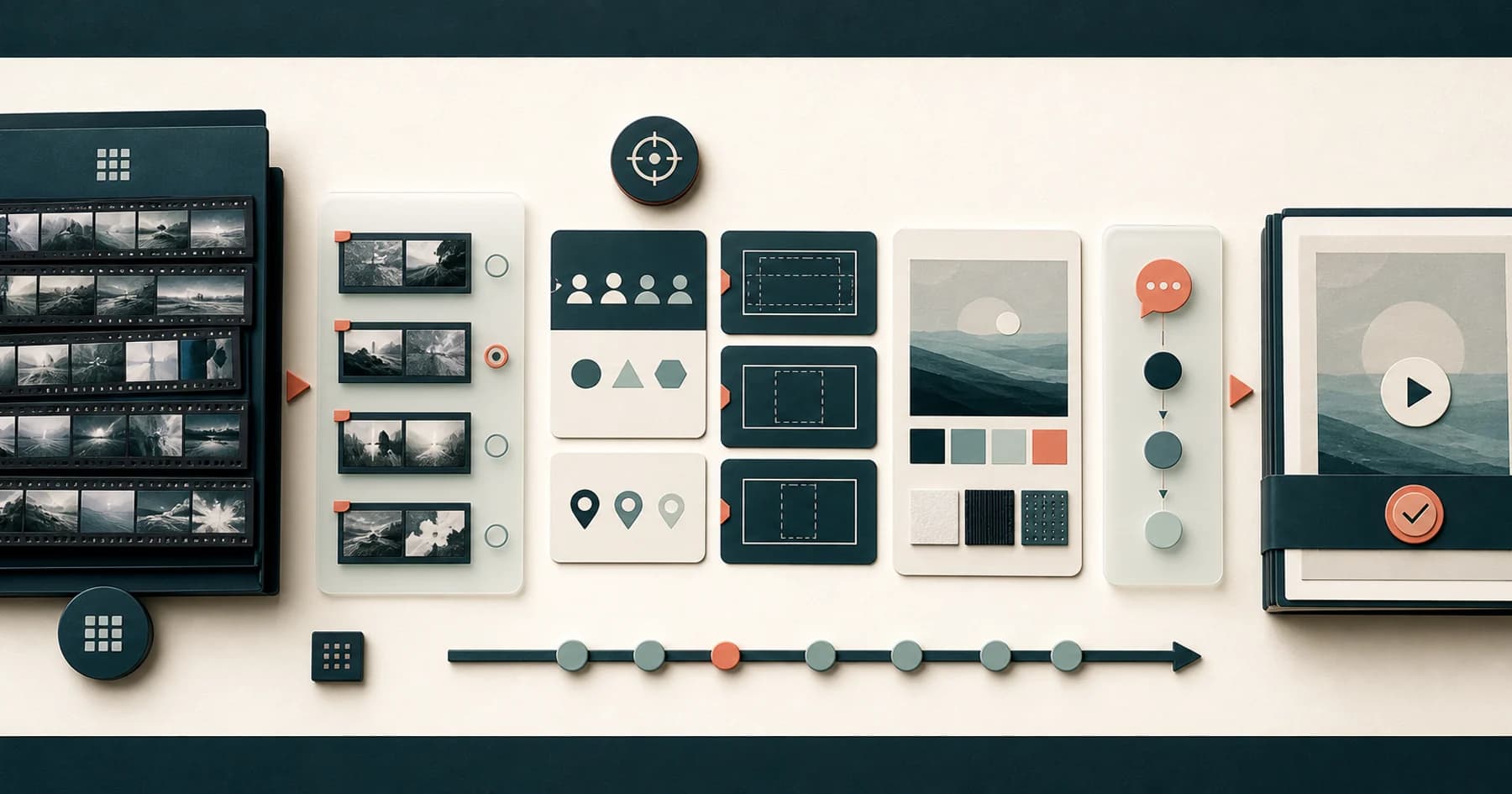
A creative brief for video should let the production team make decisions without guessing. It does not need to be long. It needs to settle the goal, audience, message, evidence, outputs, assets, and approval path before editing or animation begins.
The template below is designed for paid-social video, but the same structure works for organic content, product videos, testimonials, and campaign cutdowns. Copy it into your project document, remove anything that does not apply, and answer the rest in plain language.
A brief is not a script
The brief explains the job. The script contains the words or scenes used to execute it.
A useful brief says who the viewer is, what they should understand, which claim is approved, where the video will run, and what must be delivered. A script then turns those decisions into narration, dialogue, on-screen text, or a scene sequence.
You can commission script development as part of production, but the writer still needs the decisions in the brief. “Make us a high-converting ad” is not a brief because it leaves the offer, audience, evidence, and placement unresolved.
Copy-and-paste creative brief for video
1. Project summary
- Working project name:
- What are we making?
- Why is this being made now?
- Where will it be used?
- Who owns final approval?
Write the summary in two or three sentences. Someone outside your company should be able to read it and understand the job without opening another document.
2. Goal and viewer action
- Primary goal: awareness, explanation, lead generation, purchase, retargeting, launch support, or another named objective.
- Desired viewer action: the one thing the viewer should do next.
- Campaign context: landing page, media plan, funnel stage, or surrounding content the video must fit.
- How the team will evaluate the creative: the campaign or communication signal your team will watch.
Do not give one short video several primary goals. A video asked to introduce the brand, explain every feature, handle objections, collect a lead, and close a sale will usually do none of those jobs clearly.
Creative also does not determine campaign results by itself. Audience, offer, placement, media buying, landing page, and follow-up all contribute. The brief should name the intended role of the video without promising an outcome the production team cannot control.
3. Audience and viewing context
- Primary audience:
- What do they already know?
- What problem or situation makes the message relevant?
- What objection matters most?
- Where are they likely to encounter the video?
“Homeowners” or “marketing teams” is usually too broad. A more useful description includes the situation: a homeowner who already knows gutter cleaning is a recurring problem, or an agency account manager whose retained creative has outgrown internal capacity.
Viewing context matters too. A visitor who pressed play on a product page has chosen to learn. A person encountering an ad in a feed has not. The same explanation cannot simply be dropped into both placements unchanged.
4. Offer, message, and approved proof
- Offer or product:
- Single message the viewer should remember:
- Primary benefit:
- Most important objection:
- Approved proof: testimonials, demonstrations, product facts, case-study evidence, warranties, or other substantiated material.
- Approved call to action:
- Claims or phrases that must not be used:
- Required disclaimers or compliance language:
Supply the exact approved wording for factual, financial, health, warranty, performance, or comparative claims. Do not ask the editor to infer what is legally or commercially approved from a product page.
If the team cannot substantiate a number, leave it out. A specific visual demonstration or customer explanation is more useful than an impressive statistic nobody can source.
5. Deliverables and placements
Name each output individually:
Include caption files, thumbnails, audio-free versions, source files, or cutdowns when they are part of the handoff. If the campaign needs several ratios, list them at briefing so each version can be composed for its frame rather than treated as an emergency crop after approval.
6. Assets supplied by your team
- Raw footage and separate audio tracks.
- Product footage, UGC, customer interviews, screenshots, or screen recordings.
- Logos, fonts, colours, brand guidelines, and existing templates.
- Landing page, product page, sales notes, and previous campaign creative.
- Approved testimonials, claims, disclaimers, and offer language.
- Music, stock, talent, or usage restrictions already attached to the assets.
- One or two references with a sentence explaining what to borrow from each.
A reference is useful when it names the decision: “use this pacing,” “the product appears this early,” or “match this text hierarchy.” A folder of ten unrelated ads labelled “inspiration” creates more questions than it answers.
7. What the production team must create
- Script, edit, animation, voiceover, sound design, captions, or static frames required.
- Missing visuals that need motion graphics or supplied stock.
- Brand elements that need to become reusable templates.
- Number and purpose of genuine creative variants.
A variant should test a meaningful difference—a new opening, message emphasis, sequence, or visual treatment. Merely changing a colour or resizing the same master does not create a useful creative comparison.
8. Review, scope, and timing
- Internal deadline: when your team needs the file for review.
- Launch or media deadline: when the approved asset must be ready.
- Review owner: the person returning one consolidated set of notes.
- Other stakeholders: who must be heard before notes are sent.
- Review stages: script, frames, rough cut, animation, or final delivery.
- Revision structure: what is included and what would count as a new direction.
- Handoff destination: folder, review platform, or project-management system.
Build room for your own review between the production deadline and campaign launch. If several stakeholders are involved, resolve conflicting comments internally before returning notes.
A real supplied-footage brief
For the Gutter Cap video-ad project, Versmos started with:
- Two finished scripts.
- A library of product and installation footage.
- A reference edit showing the intended pacing and treatment.
- Brand assets for both the manufacturer and local installer.
Those inputs answered the important production questions. The two scripts allowed genuine variants. The footage library established what could be shown. The reference reduced stylistic guesswork. The dual brand kit made the manufacturer-versus-installer hierarchy visible before editing began.
Where footage did not cover a script beat, motion graphics and text carried it deliberately. You can see the production decisions and both finished ads in the full Gutter Cap case study.
Common briefing mistakes
Starting with style instead of the job
“Modern, dynamic, premium” does not identify the audience, message, placement, or deliverables. Set those first. Style becomes easier to judge once everyone knows what the video must do.
Leaving variants until after the master is approved
If testing matters, identify what each version changes at the script or storyboard stage. Retrofitting “three variants” from one locked edit usually produces three files with the same underlying idea.
Treating format as an export setting
A vertical frame, feed frame, and landscape frame have different available space. Critical text and product details need to be composed for each one, not simply cropped into place.
Sending unapproved claims
Production should never be the first team to decide whether a performance claim, testimonial, warranty statement, or regulated phrase is allowed. Supply approved wording and its required disclaimer.
Letting feedback arrive from several directions
One review owner should return one set of reconciled notes. Production is the wrong place to discover that two internal stakeholders want different messages.
Final brief checklist
- The project and its timing are clear.
- One audience, message, and viewer action are named.
- The offer, approved proof, CTA, and restrictions are supplied.
- Every deliverable and placement is listed.
- Footage, audio, brand assets, and references are organized.
- Missing graphics, script work, or voiceover are in scope.
- Variants have a reason to be different.
- One person owns consolidated feedback.
- Review stages, deadlines, and final handoff are agreed.
For an explainer rather than a paid campaign, use the more specific explainer video briefing checklist. If your paid-video brief is ready, review our video ad production service, learn how motion graphics support Meta ad variations, or apply with the project details.